Sunday, August 31, 2014

Falafels + Tahini Sauce Veggie Feast!

While visiting Glacier National Park this summer, we ate at a phenomenal gluten-free and vegan friendly restaurant: Wrap and Roll! Besides playing jammin' music, they had amazing veggie tahini sauce wraps and falafel wraps.

Now that we're back home and time zones away from that delicious eatery, we tried to recreate our favorite dishes there. Wasn't quite the same, but still delicious!

Falafels made by Nick

Grilling mushrooms

Grilling bell-peppers and zuchinni
To make the falafels, Nick followed this recipe. While the veggies grilled, we cooked up rice. We tried to put the rice veggies and tahini sauce (used this recipe) in corn flour wraps, but the gluten-free tortillas were too small and kept ripping. We've just been eating the veggies and falafels with tahini sauce and rice.

A happy herbivore in Glacier National Park :-) 

Tuesday, July 9, 2013

Nepali reasons to be on a plant based diet.

Reason #1
Well that meat sure looks sanitary... Keep in mind this picture was taken in above 80F heat, above 80% humidity, and flies were everywhere.

Reason #2

Buddha is watching. Don't let your karma accumulate! That meat could have been your grandpa's reincarnation! ;-)

This was meant as a joke, although these probably are the top two reasons (in reverse order) why most Nepali vegetarians don't eat meat.

Nepal trip foods

While Kathmandu is almost as the same elevation as Boulder, there is a reason Kathmandu is not also a running mecca. Extremely humid and crowded, to avoid traffic, pollution, and poop, I ran 111 miles (~60mpw) on the 300m driveway of the Shanker Hotel. The hotel used to be Prime Minister Juddha Shumsher's palace so the driveway is a big loop around a lush courtyard.

The driveway wraps around this courtyart.

By the hotel entrance.

One stretch of the driveway.
Luckily winters in Ithaca, NY have provided me with many miles of indoor running and that conditioning (plus my iPod) helped me get through running in circles.  Running is not very common in Nepal, so the hotel guards often asked me if I was "a marathon player." :-)

Whatever Kathmandu lacks in running, for better or worse, it makes up in having ample delicious whole plant-based foods.
Bike vendors with veggies are very common.

Puts most grocery stores' pepper sections to shame! Left to right: peppers, tomatoes,  onions.

Mobile or stationary produce! 
Typical Nepali meals feature a variety of vegetable dishes and are always eaten with cooked rice (bhat) and lentils (dal).
A typical Nepal meal.
In this meal, prepared by my Nepali grandmother, there is aloo (fried potato, left-most corner), tomato achar (the red dish), dal (the two bowls of yellow soup), and another aloo dish (the bowl to the left of the lower dal bowl). On my father's plate you can also see some saag (in this case cooked squash tips) and radish achar (the brown bits between the saag and aloo on his plate). Eventually, recipes for each of those dishes will be posted on this blog.
I will also eventually post the recipe for my grandma's delicious mushroom dish.

While in Nepal I generally did not eat my typical oatmeal breakfast, but instead ate Nepali hashbrowns (fried aloo with some spices and greens mixed in) and dosas. 
Me eating a plain dosa and black tea.
Dosas are generally stuffed with aloo and spices, or eaten with curry, but right after my morning run I just wanted to snarf down the dosa plain. I will not post recipes for dosas because just as you can buy brownie or cake mixes in grocery stores, if you go to an Indian grocery store they definitely will sell dosa mixes. Then, as long as you have a frying pan, you can follow the mix's instructions and make a dosa!

While in Nepal, we did a trek to Gosaikunda with Peace Nepal Treks. You can see the trek here and maps of it below.
This map includes the points along our trek.


View Nepal 2013 in a larger map

During this trek, I saw Nepal food preparation in action! Like Des Moines being surrounded by corn fields, Kathmandu is instead surrounded by rice paddies.
Rice paddie.
Houses built in-between paddies.
A house being built between paddies.
Tomatoes being farmed by the rice paddies.


Alternating between corn and rice.
 While rice certainly is the main staple for Nepali people, there were also many terraces of corn.


You may have noticed that not all those crops were just corn! Marijuana is harvested both for its non-potent seeds to be used as a spice in dishes, and for its potent leaves used for...well, you know.
The religious use of marijuana; at Muktinath temple.
Lastly, seeds, rice, vegetables, and spices are often dried for preservation and transport. Here are some typical pictures of this.
Outskirts of Kathmandu.

On the way to Chisopani.

At Phedi, saag being dried within the lodge to preserve it for winter.

That's all for now! Stay tuned and namaste.


Sunday, June 23, 2013

By request: Pesto!

Requested by my little sis, a delicious cheese free pesto!

Ingredients:

  • An avocado
    This was the biggest avocado I had ever encountered. I ate it whole, otherwise it would have been great for pesto!
  • A LOT OF BASIL! I typically buy two of the hydroponically grown basils or two of Wegman's basil clamshells. 
    At least twice this much basil!
  • Garlic
    At least this many cloves of garlic
  • Olive oil
  • Salt
  • Optional: pine nuts (which I'm generally too cheap to buy) or walnuts (which can be )


Directions
1. Peel & chop the garlic. 

2. Blend peeled avocado, garlic, and basil with some water and olive oil until is at an ideal consistency. Add salt. Optional: also blend in pine nuts.

3. Optional: when serving, sprinkle walnuts on top of dish.


Running relevant info on the main ingredients. The serving size (grams given), carbs (grams), dietary fiber (grams), fat (grams), protein (grams), amino acid score, and calcium & iron as percent of daily value.

Wednesday, May 29, 2013

Off to Nepal!

Today I leave for Nepal! I'll post different recipes and meals I come across while we're there. Stay tuned!

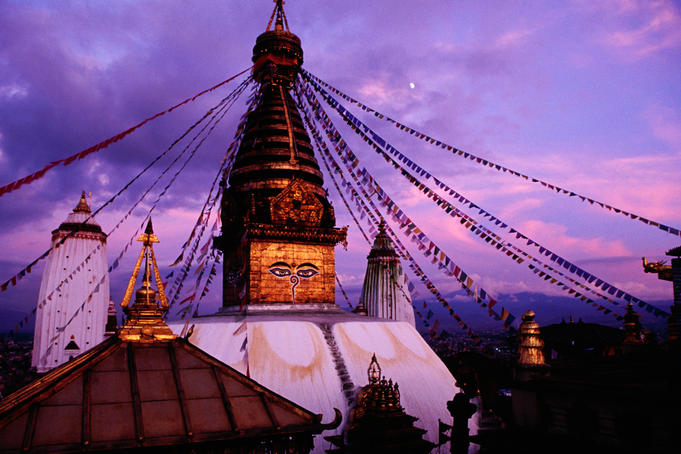
Swayambhunath, Kathmandu, Nepal


Nepali eggplant & red beans

Left side of plate: Eggplant & scallions; right side of plate: red beans.

This will be the first of many Nepali recipes, especially since I am about to spend three weeks in Nepal!

These dishes are very easy to make and the ingredients are super cheap :-)

Nepali red beans
Ingredients:

  • Cans of red kidney beans
  • Can of tomato paste
  • Tomatoes
  • Oil (optimal is vegetable/canola oil)
  • Onion
  • Garlic
  • Ginger
  • Spice: cinnamon sticks, anise seeds, red chili, bay leaves, turmeric

The amount of each depends on how much you're cooking and how spicy you want it to be. Next time I cook it I'll take pictures of each step and update this to show the amount of ingredients used. Hint: better to use too much garlic, ginger, and spices than too little!

Directions:

  1. Heat vegetable oil with some anise seeds and pieces of cinnamon sticks.
  2. When the anise seeds start to pop, turn off the heat, add some small pieces of ginger, red chillies and turmeric, and shake with lid on.
  3. Add the red kidney beans when the pot is cool, and crushed garlic, tomato paste, water, salt, powdered cumin, coriander, black pepper and cinnamon.
  4. Optional: add cubed fresh tomatoes and big bay leaves. Heat to a boil.

Running relevant info on the main ingredients. The serving size (grams given), carbs (grams), dietary fiber (grams), fat (grams), protein (grams), amino acid score, and calcium & iron as percent of daily value.


Nepali eggplant
Ingredients:

  • Oil (optimal is vegetable/canola oil)
  • Eggplant
  • Green onions or leeks
  • Crimini mushrooms (optional)
  • Spices: turmeric, cumin, coriander, and salt

Directions:
  1. Saute chopped mushrooms in oil with turmeric (optional)
  2. When oil is hot, add turmeric and place chopped eggplant in pot
  3. When eggplant starts browning add chopped leeks.
  4. Mix in salt, cumin, and coriander

Running relevant info on the main ingredients. The serving size (grams given), carbs (grams), dietary fiber (grams), fat (grams), protein (grams), amino acid score, and calcium & iron as percent of daily value.


the finished product!

Thursday, May 23, 2013

Welcome!

There is a general misconception to be an athlete, especially a high-performing (or novice) distance runner, requires eating a lot of meat! This simply is not true, and instead a plant-based diet can not only provide you with all the nutrients you need, it can help you be a lean-mean running machine!

This blog is not going to be focused on the science of plant based eating. Check http://www.thechinastudy.com/ for more information about that. 


The focus of this blog is providing recipes and information on great meals that are nice to fantasize about while running and even nicer to eat after (or before) a run!


I'll add a post to this site every week or two. Each blog will include a recipe, some nutrition facts especially useful for runners (ie. iron, protein, calcium), and a picture of the finished product. Sometimes I'll post a feature on a vegan athlete.  There will of course be a very strong bias towards track and field athletes and marathoners/ultrarunners.


Eat plants, go run.

Pill supplements: 

I should probably mention here that ever since I started distance running I've taken iron pills. Some people absorb iron really easily, others don't. Some pills absorb easily, others don't. To figure out which works for you I recommend checking out this blog post

Since becoming vegan, I've added B12 pills to that regime. If you drink dark beer or eat whole grain wheat bread often, depending on your mileage you may be able to skip taking B12. However, if you're above 50 miles per week (mpw) and/or training at altitude, you may feel better taking B12 supplements. Since this site isn't offering medical advice and I'm not a dietician, this is something to either ask a doctor/nutritionist or look into elsewhere. 

Besides iron and B12, I take no other nutritional supplements.